Zum Hauptinhalt springen

iMSL – Intelligent Material Systems Lab – Lehrstuhl für intelligente Materialsysteme an der Universität des Saarlandes

Transdes

Development of Novel Transistor Structures Based on Flexible Dielectric Elastomer Switch

The research project TransDES focuses on the development of novel, flexible switching structures based on silicone dielectric elastomers with thin-film metal electrode. The aim is to exploit the unique electromechanical properties of these smart materials to develop compact and flexible electronic components.

The project is carried out by Saarland University (UdS), under the direction of Prof. Dr.-Ing. Paul Motzki, in collaboration with the University of Applied Sciences Saarland (htw saar), under the direction of Prof. Dr.-Ing. John Heppe. The research activities are conducted in close cooperation at the Center for Mechatronics and Automation Technology (ZeMA) in Saarbrücken. 

Problem Statement

Dielectric Elastomers (DEs) are thin, flexible polymer films coated with electrically conductive electrodes. Due to their low weight, high flexibility, and ability to function as both actuators and sensors, they offer significant potential for innovative technological applications. 

However, dielectric elastomer actuators often require high operating voltages. Conventional high-voltage switches are based on rigid semiconductor components, which require additional installation space and complicate integration into flexible systems. At the same time, conventional stretchable electrodes based on carbon materials exhibit relatively high electrical resistance, limiting their suitability for efficient switching applications. 

A key challenge is therefore to develop flexible electrode structures whose electrical resistance can be deliberately and reversibly controlled through mechanical deformation. This would enable the direct integration of electrical switching functions into dielectric elastomer systems. 

Objectives

The objective of TransDES is to investigate and develop novel flexible switching structures based on dielectric elastomers. By combining elastic polymer films with thin-film metallic electrodes, the project aims to realize components whose electrical resistance can be switched between low- and high-resistance states through mechanical deformation. 

The research focuses on developing compact switching concepts, particularly for high-voltage and energy transfer applications. In the long term, the results are expected to contribute to the direct integration of electronic switching functions into flexible actuator systems, establishing the foundation for a new generation of flexible high-voltage electronic circuits. 

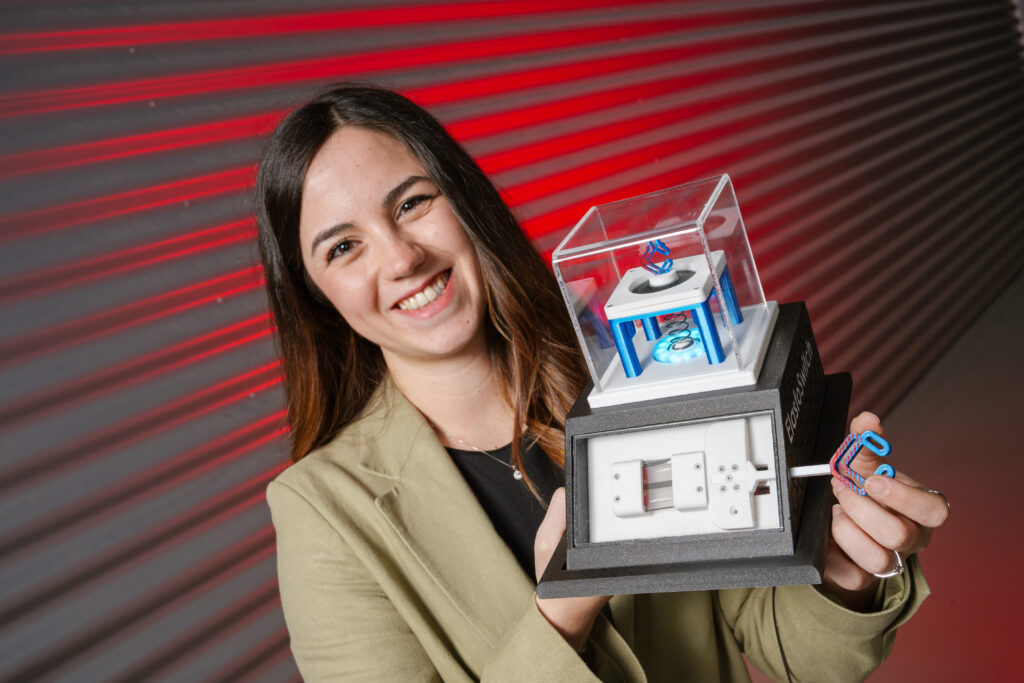
Photo by: Mr. Oliver Dietze

Approach

The research activities are conducted in close collaboration between Saarland University and htw saar. While the research group of Prof. John Heppe contributes expertise in metallic thin films and flexible electrode structures, the group of Prof. Paul Motzki focuses on the development, integration, and electromechanical characterization of dielectric elastomer switches. 

A central aspect of the research at Saarland University is the investigation of the relationship between mechanical deformation and the electrical resistance of the novel electrode structures. For this purpose, elastic silicone films are combined with thin-film metallic electrodes. Under mechanical stretching, microscopic cracks form in the conductive layer, resulting in a significant increase in electrical resistance. When the material is relaxed, these cracks close again, restoring electrical conductivity. 

The developed structures are experimentally characterized in terms of switching behaviour, resistance variation, and repeatability. Furthermore, concepts for integrating flexible switching elements into dielectric elastomer actuators and electronic circuits are investigated. 

By combining material development, experimental characterization, and system-level integration, the project aims to establish the technological foundations for a new generation of flexible electronic components. 

Results and Current Status

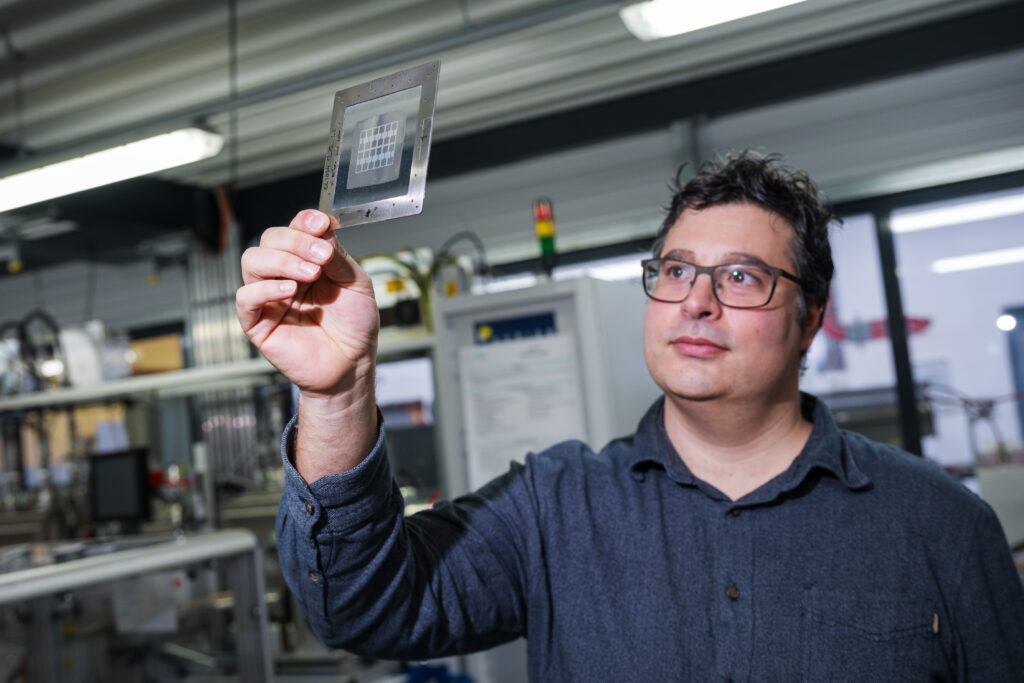
Within the TransDES project, the first functional demonstrators of flexible electrical switches based on silicone membrane and thin-film metal electrodes have been successfully developed. The novel metal-coated elastomer films exhibit a pronounced and reversible change in electrical resistance as a result of mechanical deformation. 

In their conductive state, the investigated structures exhibit electrical resistance values in the range of approximately 50–100 Ω. When mechanically stretched, their resistance increases to the high-megaohm range, effectively interrupting the electrical current. This behaviour enables mechanically controlled switching elements with a large ON/OFF resistance ratio. 

The switching principle has been demonstrated using a prototype in which the deformation of the elastomer film is controlled to open and close an electrical circuit. The technology was presented at Hannover Messe 2026. 

These results highlight the potential of dielectric elastomers as a basis for novel flexible switches. In the future, such structures could contribute to the development of integrated, lightweight, and adaptable electronic systems, particularly for smart actuators, pumps, valves, and energy transfer applications. 

 Project Leader (Saarland University): Prof. Dr.-Ing. Paul Motzki 

Project Partners: Saarland University (UdS), University of Applied Sciences Saarland (htw saar) 

Research Collaboration: Center for Mechatronics and Automation Technology (ZeMA) 

Funding: European Regional Development Fund (ERDF/EFRE)

Project Duration: 01.04.2024-31.05.2027 

Photo by: Mr. Oliver Dietze